
History

The Church has her origin with Jesus Christ and the Holy Spirit, not with a human teacher, or group, nor a code of conduct or religious philosophy. Orthodoxy believes that the Church has her origin in the Apostolic Community called into being by Jesus Christ, and enlivened by the Holy Spirit. The Feast of Pentecost, which is celebrated fifty days after Easter, commemorates the “outpouring” of the Holy Spirit upon the Apostles and marks the beginning of the mission of the Church to the world. The Orthodox Church believes that she has maintained a direct and unbroken continuity of love, faith, and order with the Church of Christ born in the Pentecost experience.
The Time of Persecution
The earliest Church, which is described in the Epistles and the Acts of the Apostles, did not confine itself to the land of Judea. She took very seriously the command of Our Lord to go into the whole world and preach the Gospel. The words of Christ and the event of His saving Death and Resurrection were destined not only for the people of the first century and the Mediterranean world of which they were a part, but also for persons in all places and in every age. Within only a few years after the Resurrection, colonies of Christians sprung in the major cities of the Roman Empire.
While the early Church received many converts from Judaism and the pagan religions, the world in which the Gospel was proclaimed was, in the words of St. Paul, “heartless and ruthless.” With only a few intervals of peace, the Church was persecuted throughout the Empire for nearly three hundred years. The faith and love expressed by the Christians were viewed as a threat to the religion and political policies of the Empire. Thousands upon thousands of Christians were martyred.
The Time of Growth
The beginning of the fourth century marked a new stage in the development of the Church. After centuries of vicious persecution at the direction of the Roman Emperors, an Emperor of Rome became a Christian. This was Constantine the Great, who in the year 313 granted Christians freedom of worship. The Edict was a recognition that the Church not only had survived the persecutions but also had become a significant force in the Empire. From that time onward, the Church and the Empire began a very close and mutually beneficial relationship. Not only did the Church receive imperial support, but also the evils which had characterized the old Roman Empire were greatly reduced in Christian Byzantium. The Church was truly a leaven of the society of which it was a part. The fourth through the tenth centuries were a significant period for the Church’s internal development. The authorative content of the New Testament was determined. The Services of Worship received a formal framework. The Teachings of Christianity were developed by great pastors and theologians who are known as the “Fathers” of the Church. It was also a period of missionary activity. Among the most important was the evangelization of the Slavs by Saints Cyril and Methodius. However, the period was not without struggle. The Byzantine Empire was constantly on guard against the neighboring Persians and Muslims. The Church itself was frequently afflicted with many grave schisms and heresies. For example, serious schisms took place in the years 431 and 451. Among the greatest heresies was Arianism, which taught that Christ was not truly God. This heresy plagued the Church and brought havoc to the Empire for nearly a century.
The fundamental doctrines of the Church were proclaimed and defended by the Seven Ecumenical Councils. These Synods, which are known by the names of the cities in which they were convened, included Bishops from throughout the world, who came to affirm the authentic teachings on the Incarnation and the Holy Trinity. The Councils did not create new doctrines, but in a particular place and time, they proclaimed what the Church always believed and taught. The counciliar and collegial expression of Church life and authority which was manifest at the Ecumenical Councils and other synods of the early Church continue to be an important aspect of Orthodox Christianity.
The Ecumenical Councils also sanctioned the organization of the Church about the five great ecclesiastical centers of Rome, Constantinople, Alexandria, Antioch, and Jerusalem. The Archbishops of these cities came to be known as Patriarchs. They presided over the synod of bishops in a particular area. Since the early Church was not monolithic, each center had its own theological style, customs, and liturgical traditions. Yet, all shared in the unity of the faith. However, a primacy of honor was accorded the Bishop of Rome, from early times. The Second Ecumenical Council (381) gave Constantinople a position of honor by stating, “The Bishop of Constantinople shall have the prerogative of honor after the Bishops of Rome, because Constantinople is New Rome.”
The Great Schism
The Great Schism is the title given to separation between the Western Church (the Roman Catholic) and the Eastern Church, (the Orthodox), which took place in the eleventh century. Relations between the two great traditions of the East and the West had often been strained since the fourth century. Yet, unity and harmony was maintained in spite of differences in theological expression, liturgical practices, and views of authority. By the ninth century, however, legitimate differences were intensified by political circumstances, cultural clashes, papal claims, and the introduction in the West of the Filioque phrase into the Nicene Creed. The Filioque affirms that the Holy Spirit proceeds from the Father and the Son. Both the papal claims and the Filioque were strongly repudiated by the East.
Although it is difficult to date the exact year of the schism, in the year 1054 official charges, known as Anathemas, were exchanged. The Crusades, and especially the sack of the city of Constantinople by the western crusaders in 1204, can be considered the final element in the process of estrangement and deepening mistrust.
From that period onward, the Western Church, centered about the Pope of Rome, and the Eastern Church, centered about the Patriarch of Constantinople, went their separate ways. Although there were attempts to restore communion in the years 1274 and 1439, there was no lasting unity achieved. While political, cultural, and emotional factors have always been involved, the Orthodox Church believes that the two principal reasons for the continued schism are the papal claims of universal jurisdiction and infallibility, as well as the meaning of the Filioque.
For nearly 500 years the two traditions lived in formal isolation from each other. Only, since the early 1960’s have steps been taken to restore the broken unity. Most significant has been the mutual lifting of the Anathemas of 1054 by the late Patriarch Athenagoras and Pope Paul VI in 1965.
Time of Struggle
In the year 1453, the City of Constantinople fell to the invading Muslims. With its capital, the Byzantine Empire came to an end; and the vast lands of Asia Minor fell subject to non-Christians. The great ecclesiastical cities of Alexandria, Antioch, and Jerusalem, which had come under the political control of Islam centuries earlier, were now joined by Constantinople. Throughout the Ottoman Empire, Christians came to be treated as second-class citizens who paid heavy taxes and wore distinctive dress. The life of the Orthodox Church in the Balkan and Asia Minor continued, but under much duress. Thousands of Christians suffered martyrdom. Patriarchs were deposed and murdered. Churches, monasteries, and schools were closed and destroyed. Only with the liberation of Greece in 1821, did some of the brutality come to an end. However, there were a series of vicious massacres at the beginning of this century. And, even today, Christians are denied their basic human rights in parts of Asia Minor.
After the decline of Byzantium, the Church in Russia thrived for nearly 500 years. However, with the Bolshevik revolution of 1917, Orthodoxy found itself confronted with the beliefs and political policies of militant atheists. Most churches were closed; and a policy was inaugurated to eliminate Christianity from Russia, a land which was steeped in Orthodoxy since the tenth century. In the years between the two World Wars, Orthodox Christians in Russia suffered much cruel and devastating persecution. Only since 1943 have there been modifications in government policy which have permitted the Church some degree of existence.
Today, in many of the lands which were once the pride and glory of Eastern Christendom, the Orthodox Church struggles amid great obstacles and persecution. It has been observed that in recent centuries there have been more martyrs than during the great persecutions of the early Church. Yet, despite injustices and indignities, the Faith survives.
Time of Renewal and Reconciliation
Throughout the past two hundred years the Orthodox Church in the Western Hemisphere has been developing as a valuable presence and distinctive witness. For example, in the United States, Orthodoxy has been recognized as one of the four major faiths. She has more than five million members, who are grouped into more than a dozen ecclesiastical jurisdictions. The Greek Orthodox Archdiocese, which is the largest, has about 500 parishes and operates church schools, parochial schools, an orphanage, a college, and a graduate theological school. Many believe that Orthodoxy in America has the potential for true renewal, creative development, and missionary activity which can contribute greatly to American life.
From the beginning of this century, the Orthodox Church has been committed to the Ecumenical Movement. This quest for Christian unity is the boldest attack on division since the early centuries of the Church. The Patriarchate of Constantinople not only inspired the movement for unity with an encyclical in 1920, but also was one of the co-founders of the World Council of Churches in 1948. The cause of Christian unity was a special concern of the late and beloved Patriarch Athenagoras. He labored greatly to promote a renewed sense of collegiality among the various Orthodox Churches, as well as to inaugurate a true dialogue with the Roman Catholic Church. In the year 1968, the Patriarch looked toward the future and declared: May the Lord of mercy send as soon as possible to our holy Eastern and Western Churches the grace of celebrating the Divine Eucharist anew and of communicating again together… The common chalice stands out luminously on the horizon of the Church.
Source: Greek Orthodox Archdiocese of America, http://www.goarch.org/ourfaith/ourfaith7052.

Lia Forakis leads the Greek Orthodox Youth Association - GOYA - ministry and helps support our other youth and young adult ministries. Lia grew up in Modesto, California, and was a member of the Annunciation parish. She attended Modesto Junior College and Long Beach City College. Lia has served the church as a Greek dance teacher at Saint George Greek Orthodox Church in Fresno; as a youth director at the Annunciation Greek Orthodox Church in Sacramento, California; and as a San Francisco Metropolis camp counselor at St. Nicholas Ranch for many years. In her spare time, she enjoys Greek dancing and playing music, and finding cool places to eat with friends.

Renée established our strategic communications plan for the parish. She manages our website and social media channels, and previously designed and produced the Resurrection monthly magazine. Renée has years of experience leading strategic communications and employee engagement for large companies. She holds a Bachelor of Science degree in Business Management from the University of Phoenix. Renée lives in San Ramon with her husband, Brad, and in her spare time, enjoys caring for her grandson, Eddie, entertaining, and rooting for the San Francisco Giants.

Roberto Jaquez is the parish "go-to person" for all operational needs. He has worked for the parish for over 20 years and became our facilities manager in 2018. Roberto loves his job and the parish. He can be found at the church almost all hours of the day and night, while also being the primary caretaker for his father. Roberto was born in Mexico and came to the United States in 1989, where he attended Laney College in Oakland, CA. In his spare time, he enjoys spending time with his big, loving family, going on long hikes, and to the movies. He's a big fan of the Dallas Cowboys, dogs, and Ron Burgundy.

Father Niko was born in Seattle, Washington and was baptized at the Church of the Annunciation in Amaliada, Greece. After graduating from the University of Washington with a Bachelor’s degree in History, he enrolled at Holy Cross Greek Orthodox School of Theology in Brookline, Massachusetts, having felt a calling from the Lord to become a priest. He finished his studies in 2008, graduating with a Master of Divinity. Upon completing his studies, he served as the Youth Director of the Metropolis of San Francisco for three years while also serving at the Greek Orthodox Cathedral of the Annunciation in San Francisco. He was ordained to the Holy Diaconate on December 14, 2008, at his home parish and was ordained to the Holy Priesthood on August 15, 2011 at the Annunciation Cathedral, after which he began serving at the Cathedral as the full-time associate pastor.

Archdeacon Justin was ordained to the Holy Diaconate by His Eminence Metropolitan Gerasimos on Sunday, April 18, 2021. He was elevated to Archdeacon on Sunday, December 24, 2023. He is a 2020 graduate of Deaconate program at Holy Cross Greek Orthodox School of Theology. Archdeacon Justin is currently the Second Vice President of the Board of Directors for Saint Nicholas Ranch and Retreat Center. He also assists the Metropolis with various legal matters. Archdeacon Justin graduated from the University of San Francisco School of Law, and is a former partner in a law firm in Oakland, CA. In addition, he earned a post-graduate Certificate from the Institute for Orthodox Christian Studies in Cambridge, UK and holds a Bachelor of Arts degree in Philosophy from Franciscan University of Steubenville. He is currently studying toward a Master of Theology from the University of Balamand.
History
Lia Forakis leads the Greek Orthodox Youth Association - GOYA - ministry and helps support our other youth and young adult ministries. Lia grew up in Modesto, California, and was a member of the Annunciation parish. She attended Modesto Junior College and Long Beach City College. Lia has served the church as a Greek dance teacher at Saint George Greek Orthodox Church in Fresno; as a youth director at the Annunciation Greek Orthodox Church in Sacramento, California; and as a San Francisco Metropolis camp counselor at St. Nicholas Ranch for many years. In her spare time, she enjoys Greek dancing and playing music, and finding cool places to eat with friends.
Renée established our strategic communications plan for the parish. She manages our website and social media channels, and previously designed and produced the Resurrection monthly magazine. Renée has years of experience leading strategic communications and employee engagement for large companies. She holds a Bachelor of Science degree in Business Management from the University of Phoenix. Renée lives in San Ramon with her husband, Brad, and in her spare time, enjoys caring for her grandson, Eddie, entertaining, and rooting for the San Francisco Giants.
Roberto Jaquez is the parish "go-to person" for all operational needs. He has worked for the parish for over 20 years and became our facilities manager in 2018. Roberto loves his job and the parish. He can be found at the church almost all hours of the day and night, while also being the primary caretaker for his father. Roberto was born in Mexico and came to the United States in 1989, where he attended Laney College in Oakland, CA. In his spare time, he enjoys spending time with his big, loving family, going on long hikes, and to the movies. He's a big fan of the Dallas Cowboys, dogs, and Ron Burgundy.
Father Niko was born in Seattle, Washington and was baptized at the Church of the Annunciation in Amaliada, Greece. After graduating from the University of Washington with a Bachelor’s degree in History, he enrolled at Holy Cross Greek Orthodox School of Theology in Brookline, Massachusetts, having felt a calling from the Lord to become a priest. He finished his studies in 2008, graduating with a Master of Divinity. Upon completing his studies, he served as the Youth Director of the Metropolis of San Francisco for three years while also serving at the Greek Orthodox Cathedral of the Annunciation in San Francisco. He was ordained to the Holy Diaconate on December 14, 2008, at his home parish and was ordained to the Holy Priesthood on August 15, 2011 at the Annunciation Cathedral, after which he began serving at the Cathedral as the full-time associate pastor.
Archdeacon Justin was ordained to the Holy Diaconate by His Eminence Metropolitan Gerasimos on Sunday, April 18, 2021. He was elevated to Archdeacon on Sunday, December 24, 2023. He is a 2020 graduate of Deaconate program at Holy Cross Greek Orthodox School of Theology. Archdeacon Justin is currently the Second Vice President of the Board of Directors for Saint Nicholas Ranch and Retreat Center. He also assists the Metropolis with various legal matters. Archdeacon Justin graduated from the University of San Francisco School of Law, and is a former partner in a law firm in Oakland, CA. In addition, he earned a post-graduate Certificate from the Institute for Orthodox Christian Studies in Cambridge, UK and holds a Bachelor of Arts degree in Philosophy from Franciscan University of Steubenville. He is currently studying toward a Master of Theology from the University of Balamand.
The Church has her origin with Jesus Christ and the Holy Spirit, not with a human teacher, or group, nor a code of conduct or religious philosophy. Orthodoxy believes that the Church has her origin in the Apostolic Community called into being by Jesus Christ, and enlivened by the Holy Spirit. The Feast of Pentecost, which is celebrated fifty days after Easter, commemorates the “outpouring” of the Holy Spirit upon the Apostles and marks the beginning of the mission of the Church to the world. The Orthodox Church believes that she has maintained a direct and unbroken continuity of love, faith, and order with the Church of Christ born in the Pentecost experience.
The Time of Persecution
The earliest Church, which is described in the Epistles and the Acts of the Apostles, did not confine itself to the land of Judea. She took very seriously the command of Our Lord to go into the whole world and preach the Gospel. The words of Christ and the event of His saving Death and Resurrection were destined not only for the people of the first century and the Mediterranean world of which they were a part, but also for persons in all places and in every age. Within only a few years after the Resurrection, colonies of Christians sprung in the major cities of the Roman Empire.
While the early Church received many converts from Judaism and the pagan religions, the world in which the Gospel was proclaimed was, in the words of St. Paul, “heartless and ruthless.” With only a few intervals of peace, the Church was persecuted throughout the Empire for nearly three hundred years. The faith and love expressed by the Christians were viewed as a threat to the religion and political policies of the Empire. Thousands upon thousands of Christians were martyred.
The Time of Growth
The beginning of the fourth century marked a new stage in the development of the Church. After centuries of vicious persecution at the direction of the Roman Emperors, an Emperor of Rome became a Christian. This was Constantine the Great, who in the year 313 granted Christians freedom of worship. The Edict was a recognition that the Church not only had survived the persecutions but also had become a significant force in the Empire. From that time onward, the Church and the Empire began a very close and mutually beneficial relationship. Not only did the Church receive imperial support, but also the evils which had characterized the old Roman Empire were greatly reduced in Christian Byzantium. The Church was truly a leaven of the society of which it was a part. The fourth through the tenth centuries were a significant period for the Church’s internal development. The authorative content of the New Testament was determined. The Services of Worship received a formal framework. The Teachings of Christianity were developed by great pastors and theologians who are known as the “Fathers” of the Church. It was also a period of missionary activity. Among the most important was the evangelization of the Slavs by Saints Cyril and Methodius. However, the period was not without struggle. The Byzantine Empire was constantly on guard against the neighboring Persians and Muslims. The Church itself was frequently afflicted with many grave schisms and heresies. For example, serious schisms took place in the years 431 and 451. Among the greatest heresies was Arianism, which taught that Christ was not truly God. This heresy plagued the Church and brought havoc to the Empire for nearly a century.
The fundamental doctrines of the Church were proclaimed and defended by the Seven Ecumenical Councils. These Synods, which are known by the names of the cities in which they were convened, included Bishops from throughout the world, who came to affirm the authentic teachings on the Incarnation and the Holy Trinity. The Councils did not create new doctrines, but in a particular place and time, they proclaimed what the Church always believed and taught. The counciliar and collegial expression of Church life and authority which was manifest at the Ecumenical Councils and other synods of the early Church continue to be an important aspect of Orthodox Christianity.
The Ecumenical Councils also sanctioned the organization of the Church about the five great ecclesiastical centers of Rome, Constantinople, Alexandria, Antioch, and Jerusalem. The Archbishops of these cities came to be known as Patriarchs. They presided over the synod of bishops in a particular area. Since the early Church was not monolithic, each center had its own theological style, customs, and liturgical traditions. Yet, all shared in the unity of the faith. However, a primacy of honor was accorded the Bishop of Rome, from early times. The Second Ecumenical Council (381) gave Constantinople a position of honor by stating, “The Bishop of Constantinople shall have the prerogative of honor after the Bishops of Rome, because Constantinople is New Rome.”
The Great Schism
The Great Schism is the title given to separation between the Western Church (the Roman Catholic) and the Eastern Church, (the Orthodox), which took place in the eleventh century. Relations between the two great traditions of the East and the West had often been strained since the fourth century. Yet, unity and harmony was maintained in spite of differences in theological expression, liturgical practices, and views of authority. By the ninth century, however, legitimate differences were intensified by political circumstances, cultural clashes, papal claims, and the introduction in the West of the Filioque phrase into the Nicene Creed. The Filioque affirms that the Holy Spirit proceeds from the Father and the Son. Both the papal claims and the Filioque were strongly repudiated by the East.
Although it is difficult to date the exact year of the schism, in the year 1054 official charges, known as Anathemas, were exchanged. The Crusades, and especially the sack of the city of Constantinople by the western crusaders in 1204, can be considered the final element in the process of estrangement and deepening mistrust.
From that period onward, the Western Church, centered about the Pope of Rome, and the Eastern Church, centered about the Patriarch of Constantinople, went their separate ways. Although there were attempts to restore communion in the years 1274 and 1439, there was no lasting unity achieved. While political, cultural, and emotional factors have always been involved, the Orthodox Church believes that the two principal reasons for the continued schism are the papal claims of universal jurisdiction and infallibility, as well as the meaning of the Filioque.
For nearly 500 years the two traditions lived in formal isolation from each other. Only, since the early 1960’s have steps been taken to restore the broken unity. Most significant has been the mutual lifting of the Anathemas of 1054 by the late Patriarch Athenagoras and Pope Paul VI in 1965.
Time of Struggle
In the year 1453, the City of Constantinople fell to the invading Muslims. With its capital, the Byzantine Empire came to an end; and the vast lands of Asia Minor fell subject to non-Christians. The great ecclesiastical cities of Alexandria, Antioch, and Jerusalem, which had come under the political control of Islam centuries earlier, were now joined by Constantinople. Throughout the Ottoman Empire, Christians came to be treated as second-class citizens who paid heavy taxes and wore distinctive dress. The life of the Orthodox Church in the Balkan and Asia Minor continued, but under much duress. Thousands of Christians suffered martyrdom. Patriarchs were deposed and murdered. Churches, monasteries, and schools were closed and destroyed. Only with the liberation of Greece in 1821, did some of the brutality come to an end. However, there were a series of vicious massacres at the beginning of this century. And, even today, Christians are denied their basic human rights in parts of Asia Minor.
After the decline of Byzantium, the Church in Russia thrived for nearly 500 years. However, with the Bolshevik revolution of 1917, Orthodoxy found itself confronted with the beliefs and political policies of militant atheists. Most churches were closed; and a policy was inaugurated to eliminate Christianity from Russia, a land which was steeped in Orthodoxy since the tenth century. In the years between the two World Wars, Orthodox Christians in Russia suffered much cruel and devastating persecution. Only since 1943 have there been modifications in government policy which have permitted the Church some degree of existence.
Today, in many of the lands which were once the pride and glory of Eastern Christendom, the Orthodox Church struggles amid great obstacles and persecution. It has been observed that in recent centuries there have been more martyrs than during the great persecutions of the early Church. Yet, despite injustices and indignities, the Faith survives.
Time of Renewal and Reconciliation
Throughout the past two hundred years the Orthodox Church in the Western Hemisphere has been developing as a valuable presence and distinctive witness. For example, in the United States, Orthodoxy has been recognized as one of the four major faiths. She has more than five million members, who are grouped into more than a dozen ecclesiastical jurisdictions. The Greek Orthodox Archdiocese, which is the largest, has about 500 parishes and operates church schools, parochial schools, an orphanage, a college, and a graduate theological school. Many believe that Orthodoxy in America has the potential for true renewal, creative development, and missionary activity which can contribute greatly to American life.
From the beginning of this century, the Orthodox Church has been committed to the Ecumenical Movement. This quest for Christian unity is the boldest attack on division since the early centuries of the Church. The Patriarchate of Constantinople not only inspired the movement for unity with an encyclical in 1920, but also was one of the co-founders of the World Council of Churches in 1948. The cause of Christian unity was a special concern of the late and beloved Patriarch Athenagoras. He labored greatly to promote a renewed sense of collegiality among the various Orthodox Churches, as well as to inaugurate a true dialogue with the Roman Catholic Church. In the year 1968, the Patriarch looked toward the future and declared: May the Lord of mercy send as soon as possible to our holy Eastern and Western Churches the grace of celebrating the Divine Eucharist anew and of communicating again together… The common chalice stands out luminously on the horizon of the Church.
Source: Greek Orthodox Archdiocese of America, http://www.goarch.org/ourfaith/ourfaith7052.
History
Lia Forakis leads the Greek Orthodox Youth Association - GOYA - ministry and helps support our other youth and young adult ministries. Lia grew up in Modesto, California, and was a member of the Annunciation parish. She attended Modesto Junior College and Long Beach City College. Lia has served the church as a Greek dance teacher at Saint George Greek Orthodox Church in Fresno; as a youth director at the Annunciation Greek Orthodox Church in Sacramento, California; and as a San Francisco Metropolis camp counselor at St. Nicholas Ranch for many years. In her spare time, she enjoys Greek dancing and playing music, and finding cool places to eat with friends.
Renée established our strategic communications plan for the parish. She manages our website and social media channels, and previously designed and produced the Resurrection monthly magazine. Renée has years of experience leading strategic communications and employee engagement for large companies. She holds a Bachelor of Science degree in Business Management from the University of Phoenix. Renée lives in San Ramon with her husband, Brad, and in her spare time, enjoys caring for her grandson, Eddie, entertaining, and rooting for the San Francisco Giants.
Roberto Jaquez is the parish "go-to person" for all operational needs. He has worked for the parish for over 20 years and became our facilities manager in 2018. Roberto loves his job and the parish. He can be found at the church almost all hours of the day and night, while also being the primary caretaker for his father. Roberto was born in Mexico and came to the United States in 1989, where he attended Laney College in Oakland, CA. In his spare time, he enjoys spending time with his big, loving family, going on long hikes, and to the movies. He's a big fan of the Dallas Cowboys, dogs, and Ron Burgundy.
Father Niko was born in Seattle, Washington and was baptized at the Church of the Annunciation in Amaliada, Greece. After graduating from the University of Washington with a Bachelor’s degree in History, he enrolled at Holy Cross Greek Orthodox School of Theology in Brookline, Massachusetts, having felt a calling from the Lord to become a priest. He finished his studies in 2008, graduating with a Master of Divinity. Upon completing his studies, he served as the Youth Director of the Metropolis of San Francisco for three years while also serving at the Greek Orthodox Cathedral of the Annunciation in San Francisco. He was ordained to the Holy Diaconate on December 14, 2008, at his home parish and was ordained to the Holy Priesthood on August 15, 2011 at the Annunciation Cathedral, after which he began serving at the Cathedral as the full-time associate pastor.
Archdeacon Justin was ordained to the Holy Diaconate by His Eminence Metropolitan Gerasimos on Sunday, April 18, 2021. He was elevated to Archdeacon on Sunday, December 24, 2023. He is a 2020 graduate of Deaconate program at Holy Cross Greek Orthodox School of Theology. Archdeacon Justin is currently the Second Vice President of the Board of Directors for Saint Nicholas Ranch and Retreat Center. He also assists the Metropolis with various legal matters. Archdeacon Justin graduated from the University of San Francisco School of Law, and is a former partner in a law firm in Oakland, CA. In addition, he earned a post-graduate Certificate from the Institute for Orthodox Christian Studies in Cambridge, UK and holds a Bachelor of Arts degree in Philosophy from Franciscan University of Steubenville. He is currently studying toward a Master of Theology from the University of Balamand.
The Church has her origin with Jesus Christ and the Holy Spirit, not with a human teacher, or group, nor a code of conduct or religious philosophy. Orthodoxy believes that the Church has her origin in the Apostolic Community called into being by Jesus Christ, and enlivened by the Holy Spirit. The Feast of Pentecost, which is celebrated fifty days after Easter, commemorates the “outpouring” of the Holy Spirit upon the Apostles and marks the beginning of the mission of the Church to the world. The Orthodox Church believes that she has maintained a direct and unbroken continuity of love, faith, and order with the Church of Christ born in the Pentecost experience.
The Time of Persecution
The earliest Church, which is described in the Epistles and the Acts of the Apostles, did not confine itself to the land of Judea. She took very seriously the command of Our Lord to go into the whole world and preach the Gospel. The words of Christ and the event of His saving Death and Resurrection were destined not only for the people of the first century and the Mediterranean world of which they were a part, but also for persons in all places and in every age. Within only a few years after the Resurrection, colonies of Christians sprung in the major cities of the Roman Empire.
While the early Church received many converts from Judaism and the pagan religions, the world in which the Gospel was proclaimed was, in the words of St. Paul, “heartless and ruthless.” With only a few intervals of peace, the Church was persecuted throughout the Empire for nearly three hundred years. The faith and love expressed by the Christians were viewed as a threat to the religion and political policies of the Empire. Thousands upon thousands of Christians were martyred.
The Time of Growth
The beginning of the fourth century marked a new stage in the development of the Church. After centuries of vicious persecution at the direction of the Roman Emperors, an Emperor of Rome became a Christian. This was Constantine the Great, who in the year 313 granted Christians freedom of worship. The Edict was a recognition that the Church not only had survived the persecutions but also had become a significant force in the Empire. From that time onward, the Church and the Empire began a very close and mutually beneficial relationship. Not only did the Church receive imperial support, but also the evils which had characterized the old Roman Empire were greatly reduced in Christian Byzantium. The Church was truly a leaven of the society of which it was a part. The fourth through the tenth centuries were a significant period for the Church’s internal development. The authorative content of the New Testament was determined. The Services of Worship received a formal framework. The Teachings of Christianity were developed by great pastors and theologians who are known as the “Fathers” of the Church. It was also a period of missionary activity. Among the most important was the evangelization of the Slavs by Saints Cyril and Methodius. However, the period was not without struggle. The Byzantine Empire was constantly on guard against the neighboring Persians and Muslims. The Church itself was frequently afflicted with many grave schisms and heresies. For example, serious schisms took place in the years 431 and 451. Among the greatest heresies was Arianism, which taught that Christ was not truly God. This heresy plagued the Church and brought havoc to the Empire for nearly a century.
The fundamental doctrines of the Church were proclaimed and defended by the Seven Ecumenical Councils. These Synods, which are known by the names of the cities in which they were convened, included Bishops from throughout the world, who came to affirm the authentic teachings on the Incarnation and the Holy Trinity. The Councils did not create new doctrines, but in a particular place and time, they proclaimed what the Church always believed and taught. The counciliar and collegial expression of Church life and authority which was manifest at the Ecumenical Councils and other synods of the early Church continue to be an important aspect of Orthodox Christianity.
The Ecumenical Councils also sanctioned the organization of the Church about the five great ecclesiastical centers of Rome, Constantinople, Alexandria, Antioch, and Jerusalem. The Archbishops of these cities came to be known as Patriarchs. They presided over the synod of bishops in a particular area. Since the early Church was not monolithic, each center had its own theological style, customs, and liturgical traditions. Yet, all shared in the unity of the faith. However, a primacy of honor was accorded the Bishop of Rome, from early times. The Second Ecumenical Council (381) gave Constantinople a position of honor by stating, “The Bishop of Constantinople shall have the prerogative of honor after the Bishops of Rome, because Constantinople is New Rome.”
The Great Schism
The Great Schism is the title given to separation between the Western Church (the Roman Catholic) and the Eastern Church, (the Orthodox), which took place in the eleventh century. Relations between the two great traditions of the East and the West had often been strained since the fourth century. Yet, unity and harmony was maintained in spite of differences in theological expression, liturgical practices, and views of authority. By the ninth century, however, legitimate differences were intensified by political circumstances, cultural clashes, papal claims, and the introduction in the West of the Filioque phrase into the Nicene Creed. The Filioque affirms that the Holy Spirit proceeds from the Father and the Son. Both the papal claims and the Filioque were strongly repudiated by the East.
Although it is difficult to date the exact year of the schism, in the year 1054 official charges, known as Anathemas, were exchanged. The Crusades, and especially the sack of the city of Constantinople by the western crusaders in 1204, can be considered the final element in the process of estrangement and deepening mistrust.
From that period onward, the Western Church, centered about the Pope of Rome, and the Eastern Church, centered about the Patriarch of Constantinople, went their separate ways. Although there were attempts to restore communion in the years 1274 and 1439, there was no lasting unity achieved. While political, cultural, and emotional factors have always been involved, the Orthodox Church believes that the two principal reasons for the continued schism are the papal claims of universal jurisdiction and infallibility, as well as the meaning of the Filioque.
For nearly 500 years the two traditions lived in formal isolation from each other. Only, since the early 1960’s have steps been taken to restore the broken unity. Most significant has been the mutual lifting of the Anathemas of 1054 by the late Patriarch Athenagoras and Pope Paul VI in 1965.
Time of Struggle
In the year 1453, the City of Constantinople fell to the invading Muslims. With its capital, the Byzantine Empire came to an end; and the vast lands of Asia Minor fell subject to non-Christians. The great ecclesiastical cities of Alexandria, Antioch, and Jerusalem, which had come under the political control of Islam centuries earlier, were now joined by Constantinople. Throughout the Ottoman Empire, Christians came to be treated as second-class citizens who paid heavy taxes and wore distinctive dress. The life of the Orthodox Church in the Balkan and Asia Minor continued, but under much duress. Thousands of Christians suffered martyrdom. Patriarchs were deposed and murdered. Churches, monasteries, and schools were closed and destroyed. Only with the liberation of Greece in 1821, did some of the brutality come to an end. However, there were a series of vicious massacres at the beginning of this century. And, even today, Christians are denied their basic human rights in parts of Asia Minor.
After the decline of Byzantium, the Church in Russia thrived for nearly 500 years. However, with the Bolshevik revolution of 1917, Orthodoxy found itself confronted with the beliefs and political policies of militant atheists. Most churches were closed; and a policy was inaugurated to eliminate Christianity from Russia, a land which was steeped in Orthodoxy since the tenth century. In the years between the two World Wars, Orthodox Christians in Russia suffered much cruel and devastating persecution. Only since 1943 have there been modifications in government policy which have permitted the Church some degree of existence.
Today, in many of the lands which were once the pride and glory of Eastern Christendom, the Orthodox Church struggles amid great obstacles and persecution. It has been observed that in recent centuries there have been more martyrs than during the great persecutions of the early Church. Yet, despite injustices and indignities, the Faith survives.
Time of Renewal and Reconciliation
Throughout the past two hundred years the Orthodox Church in the Western Hemisphere has been developing as a valuable presence and distinctive witness. For example, in the United States, Orthodoxy has been recognized as one of the four major faiths. She has more than five million members, who are grouped into more than a dozen ecclesiastical jurisdictions. The Greek Orthodox Archdiocese, which is the largest, has about 500 parishes and operates church schools, parochial schools, an orphanage, a college, and a graduate theological school. Many believe that Orthodoxy in America has the potential for true renewal, creative development, and missionary activity which can contribute greatly to American life.
From the beginning of this century, the Orthodox Church has been committed to the Ecumenical Movement. This quest for Christian unity is the boldest attack on division since the early centuries of the Church. The Patriarchate of Constantinople not only inspired the movement for unity with an encyclical in 1920, but also was one of the co-founders of the World Council of Churches in 1948. The cause of Christian unity was a special concern of the late and beloved Patriarch Athenagoras. He labored greatly to promote a renewed sense of collegiality among the various Orthodox Churches, as well as to inaugurate a true dialogue with the Roman Catholic Church. In the year 1968, the Patriarch looked toward the future and declared: May the Lord of mercy send as soon as possible to our holy Eastern and Western Churches the grace of celebrating the Divine Eucharist anew and of communicating again together… The common chalice stands out luminously on the horizon of the Church.
Source: Greek Orthodox Archdiocese of America, http://www.goarch.org/ourfaith/ourfaith7052.
History
The Church has her origin with Jesus Christ and the Holy Spirit, not with a human teacher, or group, nor a code of conduct or religious philosophy. Orthodoxy believes that the Church has her origin in the Apostolic Community called into being by Jesus Christ, and enlivened by the Holy Spirit. The Feast of Pentecost, which is celebrated fifty days after Easter, commemorates the “outpouring” of the Holy Spirit upon the Apostles and marks the beginning of the mission of the Church to the world. The Orthodox Church believes that she has maintained a direct and unbroken continuity of love, faith, and order with the Church of Christ born in the Pentecost experience.
The Time of Persecution
The earliest Church, which is described in the Epistles and the Acts of the Apostles, did not confine itself to the land of Judea. She took very seriously the command of Our Lord to go into the whole world and preach the Gospel. The words of Christ and the event of His saving Death and Resurrection were destined not only for the people of the first century and the Mediterranean world of which they were a part, but also for persons in all places and in every age. Within only a few years after the Resurrection, colonies of Christians sprung in the major cities of the Roman Empire.
While the early Church received many converts from Judaism and the pagan religions, the world in which the Gospel was proclaimed was, in the words of St. Paul, “heartless and ruthless.” With only a few intervals of peace, the Church was persecuted throughout the Empire for nearly three hundred years. The faith and love expressed by the Christians were viewed as a threat to the religion and political policies of the Empire. Thousands upon thousands of Christians were martyred.
The Time of Growth
The beginning of the fourth century marked a new stage in the development of the Church. After centuries of vicious persecution at the direction of the Roman Emperors, an Emperor of Rome became a Christian. This was Constantine the Great, who in the year 313 granted Christians freedom of worship. The Edict was a recognition that the Church not only had survived the persecutions but also had become a significant force in the Empire. From that time onward, the Church and the Empire began a very close and mutually beneficial relationship. Not only did the Church receive imperial support, but also the evils which had characterized the old Roman Empire were greatly reduced in Christian Byzantium. The Church was truly a leaven of the society of which it was a part. The fourth through the tenth centuries were a significant period for the Church’s internal development. The authorative content of the New Testament was determined. The Services of Worship received a formal framework. The Teachings of Christianity were developed by great pastors and theologians who are known as the “Fathers” of the Church. It was also a period of missionary activity. Among the most important was the evangelization of the Slavs by Saints Cyril and Methodius. However, the period was not without struggle. The Byzantine Empire was constantly on guard against the neighboring Persians and Muslims. The Church itself was frequently afflicted with many grave schisms and heresies. For example, serious schisms took place in the years 431 and 451. Among the greatest heresies was Arianism, which taught that Christ was not truly God. This heresy plagued the Church and brought havoc to the Empire for nearly a century.
The fundamental doctrines of the Church were proclaimed and defended by the Seven Ecumenical Councils. These Synods, which are known by the names of the cities in which they were convened, included Bishops from throughout the world, who came to affirm the authentic teachings on the Incarnation and the Holy Trinity. The Councils did not create new doctrines, but in a particular place and time, they proclaimed what the Church always believed and taught. The counciliar and collegial expression of Church life and authority which was manifest at the Ecumenical Councils and other synods of the early Church continue to be an important aspect of Orthodox Christianity.
The Ecumenical Councils also sanctioned the organization of the Church about the five great ecclesiastical centers of Rome, Constantinople, Alexandria, Antioch, and Jerusalem. The Archbishops of these cities came to be known as Patriarchs. They presided over the synod of bishops in a particular area. Since the early Church was not monolithic, each center had its own theological style, customs, and liturgical traditions. Yet, all shared in the unity of the faith. However, a primacy of honor was accorded the Bishop of Rome, from early times. The Second Ecumenical Council (381) gave Constantinople a position of honor by stating, “The Bishop of Constantinople shall have the prerogative of honor after the Bishops of Rome, because Constantinople is New Rome.”
The Great Schism
The Great Schism is the title given to separation between the Western Church (the Roman Catholic) and the Eastern Church, (the Orthodox), which took place in the eleventh century. Relations between the two great traditions of the East and the West had often been strained since the fourth century. Yet, unity and harmony was maintained in spite of differences in theological expression, liturgical practices, and views of authority. By the ninth century, however, legitimate differences were intensified by political circumstances, cultural clashes, papal claims, and the introduction in the West of the Filioque phrase into the Nicene Creed. The Filioque affirms that the Holy Spirit proceeds from the Father and the Son. Both the papal claims and the Filioque were strongly repudiated by the East.
Although it is difficult to date the exact year of the schism, in the year 1054 official charges, known as Anathemas, were exchanged. The Crusades, and especially the sack of the city of Constantinople by the western crusaders in 1204, can be considered the final element in the process of estrangement and deepening mistrust.
From that period onward, the Western Church, centered about the Pope of Rome, and the Eastern Church, centered about the Patriarch of Constantinople, went their separate ways. Although there were attempts to restore communion in the years 1274 and 1439, there was no lasting unity achieved. While political, cultural, and emotional factors have always been involved, the Orthodox Church believes that the two principal reasons for the continued schism are the papal claims of universal jurisdiction and infallibility, as well as the meaning of the Filioque.
For nearly 500 years the two traditions lived in formal isolation from each other. Only, since the early 1960’s have steps been taken to restore the broken unity. Most significant has been the mutual lifting of the Anathemas of 1054 by the late Patriarch Athenagoras and Pope Paul VI in 1965.
Time of Struggle
In the year 1453, the City of Constantinople fell to the invading Muslims. With its capital, the Byzantine Empire came to an end; and the vast lands of Asia Minor fell subject to non-Christians. The great ecclesiastical cities of Alexandria, Antioch, and Jerusalem, which had come under the political control of Islam centuries earlier, were now joined by Constantinople. Throughout the Ottoman Empire, Christians came to be treated as second-class citizens who paid heavy taxes and wore distinctive dress. The life of the Orthodox Church in the Balkan and Asia Minor continued, but under much duress. Thousands of Christians suffered martyrdom. Patriarchs were deposed and murdered. Churches, monasteries, and schools were closed and destroyed. Only with the liberation of Greece in 1821, did some of the brutality come to an end. However, there were a series of vicious massacres at the beginning of this century. And, even today, Christians are denied their basic human rights in parts of Asia Minor.
After the decline of Byzantium, the Church in Russia thrived for nearly 500 years. However, with the Bolshevik revolution of 1917, Orthodoxy found itself confronted with the beliefs and political policies of militant atheists. Most churches were closed; and a policy was inaugurated to eliminate Christianity from Russia, a land which was steeped in Orthodoxy since the tenth century. In the years between the two World Wars, Orthodox Christians in Russia suffered much cruel and devastating persecution. Only since 1943 have there been modifications in government policy which have permitted the Church some degree of existence.
Today, in many of the lands which were once the pride and glory of Eastern Christendom, the Orthodox Church struggles amid great obstacles and persecution. It has been observed that in recent centuries there have been more martyrs than during the great persecutions of the early Church. Yet, despite injustices and indignities, the Faith survives.
Time of Renewal and Reconciliation
Throughout the past two hundred years the Orthodox Church in the Western Hemisphere has been developing as a valuable presence and distinctive witness. For example, in the United States, Orthodoxy has been recognized as one of the four major faiths. She has more than five million members, who are grouped into more than a dozen ecclesiastical jurisdictions. The Greek Orthodox Archdiocese, which is the largest, has about 500 parishes and operates church schools, parochial schools, an orphanage, a college, and a graduate theological school. Many believe that Orthodoxy in America has the potential for true renewal, creative development, and missionary activity which can contribute greatly to American life.
From the beginning of this century, the Orthodox Church has been committed to the Ecumenical Movement. This quest for Christian unity is the boldest attack on division since the early centuries of the Church. The Patriarchate of Constantinople not only inspired the movement for unity with an encyclical in 1920, but also was one of the co-founders of the World Council of Churches in 1948. The cause of Christian unity was a special concern of the late and beloved Patriarch Athenagoras. He labored greatly to promote a renewed sense of collegiality among the various Orthodox Churches, as well as to inaugurate a true dialogue with the Roman Catholic Church. In the year 1968, the Patriarch looked toward the future and declared: May the Lord of mercy send as soon as possible to our holy Eastern and Western Churches the grace of celebrating the Divine Eucharist anew and of communicating again together… The common chalice stands out luminously on the horizon of the Church.
Source: Greek Orthodox Archdiocese of America, http://www.goarch.org/ourfaith/ourfaith7052.
History
The Church has her origin with Jesus Christ and the Holy Spirit, not with a human teacher, or group, nor a code of conduct or religious philosophy. Orthodoxy believes that the Church has her origin in the Apostolic Community called into being by Jesus Christ, and enlivened by the Holy Spirit. The Feast of Pentecost, which is celebrated fifty days after Easter, commemorates the “outpouring” of the Holy Spirit upon the Apostles and marks the beginning of the mission of the Church to the world. The Orthodox Church believes that she has maintained a direct and unbroken continuity of love, faith, and order with the Church of Christ born in the Pentecost experience.
The Time of Persecution
The earliest Church, which is described in the Epistles and the Acts of the Apostles, did not confine itself to the land of Judea. She took very seriously the command of Our Lord to go into the whole world and preach the Gospel. The words of Christ and the event of His saving Death and Resurrection were destined not only for the people of the first century and the Mediterranean world of which they were a part, but also for persons in all places and in every age. Within only a few years after the Resurrection, colonies of Christians sprung in the major cities of the Roman Empire.
While the early Church received many converts from Judaism and the pagan religions, the world in which the Gospel was proclaimed was, in the words of St. Paul, “heartless and ruthless.” With only a few intervals of peace, the Church was persecuted throughout the Empire for nearly three hundred years. The faith and love expressed by the Christians were viewed as a threat to the religion and political policies of the Empire. Thousands upon thousands of Christians were martyred.
The Time of Growth
The beginning of the fourth century marked a new stage in the development of the Church. After centuries of vicious persecution at the direction of the Roman Emperors, an Emperor of Rome became a Christian. This was Constantine the Great, who in the year 313 granted Christians freedom of worship. The Edict was a recognition that the Church not only had survived the persecutions but also had become a significant force in the Empire. From that time onward, the Church and the Empire began a very close and mutually beneficial relationship. Not only did the Church receive imperial support, but also the evils which had characterized the old Roman Empire were greatly reduced in Christian Byzantium. The Church was truly a leaven of the society of which it was a part. The fourth through the tenth centuries were a significant period for the Church’s internal development. The authorative content of the New Testament was determined. The Services of Worship received a formal framework. The Teachings of Christianity were developed by great pastors and theologians who are known as the “Fathers” of the Church. It was also a period of missionary activity. Among the most important was the evangelization of the Slavs by Saints Cyril and Methodius. However, the period was not without struggle. The Byzantine Empire was constantly on guard against the neighboring Persians and Muslims. The Church itself was frequently afflicted with many grave schisms and heresies. For example, serious schisms took place in the years 431 and 451. Among the greatest heresies was Arianism, which taught that Christ was not truly God. This heresy plagued the Church and brought havoc to the Empire for nearly a century.
The fundamental doctrines of the Church were proclaimed and defended by the Seven Ecumenical Councils. These Synods, which are known by the names of the cities in which they were convened, included Bishops from throughout the world, who came to affirm the authentic teachings on the Incarnation and the Holy Trinity. The Councils did not create new doctrines, but in a particular place and time, they proclaimed what the Church always believed and taught. The counciliar and collegial expression of Church life and authority which was manifest at the Ecumenical Councils and other synods of the early Church continue to be an important aspect of Orthodox Christianity.
The Ecumenical Councils also sanctioned the organization of the Church about the five great ecclesiastical centers of Rome, Constantinople, Alexandria, Antioch, and Jerusalem. The Archbishops of these cities came to be known as Patriarchs. They presided over the synod of bishops in a particular area. Since the early Church was not monolithic, each center had its own theological style, customs, and liturgical traditions. Yet, all shared in the unity of the faith. However, a primacy of honor was accorded the Bishop of Rome, from early times. The Second Ecumenical Council (381) gave Constantinople a position of honor by stating, “The Bishop of Constantinople shall have the prerogative of honor after the Bishops of Rome, because Constantinople is New Rome.”
The Great Schism
The Great Schism is the title given to separation between the Western Church (the Roman Catholic) and the Eastern Church, (the Orthodox), which took place in the eleventh century. Relations between the two great traditions of the East and the West had often been strained since the fourth century. Yet, unity and harmony was maintained in spite of differences in theological expression, liturgical practices, and views of authority. By the ninth century, however, legitimate differences were intensified by political circumstances, cultural clashes, papal claims, and the introduction in the West of the Filioque phrase into the Nicene Creed. The Filioque affirms that the Holy Spirit proceeds from the Father and the Son. Both the papal claims and the Filioque were strongly repudiated by the East.
Although it is difficult to date the exact year of the schism, in the year 1054 official charges, known as Anathemas, were exchanged. The Crusades, and especially the sack of the city of Constantinople by the western crusaders in 1204, can be considered the final element in the process of estrangement and deepening mistrust.
From that period onward, the Western Church, centered about the Pope of Rome, and the Eastern Church, centered about the Patriarch of Constantinople, went their separate ways. Although there were attempts to restore communion in the years 1274 and 1439, there was no lasting unity achieved. While political, cultural, and emotional factors have always been involved, the Orthodox Church believes that the two principal reasons for the continued schism are the papal claims of universal jurisdiction and infallibility, as well as the meaning of the Filioque.
For nearly 500 years the two traditions lived in formal isolation from each other. Only, since the early 1960’s have steps been taken to restore the broken unity. Most significant has been the mutual lifting of the Anathemas of 1054 by the late Patriarch Athenagoras and Pope Paul VI in 1965.
Time of Struggle
In the year 1453, the City of Constantinople fell to the invading Muslims. With its capital, the Byzantine Empire came to an end; and the vast lands of Asia Minor fell subject to non-Christians. The great ecclesiastical cities of Alexandria, Antioch, and Jerusalem, which had come under the political control of Islam centuries earlier, were now joined by Constantinople. Throughout the Ottoman Empire, Christians came to be treated as second-class citizens who paid heavy taxes and wore distinctive dress. The life of the Orthodox Church in the Balkan and Asia Minor continued, but under much duress. Thousands of Christians suffered martyrdom. Patriarchs were deposed and murdered. Churches, monasteries, and schools were closed and destroyed. Only with the liberation of Greece in 1821, did some of the brutality come to an end. However, there were a series of vicious massacres at the beginning of this century. And, even today, Christians are denied their basic human rights in parts of Asia Minor.
After the decline of Byzantium, the Church in Russia thrived for nearly 500 years. However, with the Bolshevik revolution of 1917, Orthodoxy found itself confronted with the beliefs and political policies of militant atheists. Most churches were closed; and a policy was inaugurated to eliminate Christianity from Russia, a land which was steeped in Orthodoxy since the tenth century. In the years between the two World Wars, Orthodox Christians in Russia suffered much cruel and devastating persecution. Only since 1943 have there been modifications in government policy which have permitted the Church some degree of existence.
Today, in many of the lands which were once the pride and glory of Eastern Christendom, the Orthodox Church struggles amid great obstacles and persecution. It has been observed that in recent centuries there have been more martyrs than during the great persecutions of the early Church. Yet, despite injustices and indignities, the Faith survives.
Time of Renewal and Reconciliation
Throughout the past two hundred years the Orthodox Church in the Western Hemisphere has been developing as a valuable presence and distinctive witness. For example, in the United States, Orthodoxy has been recognized as one of the four major faiths. She has more than five million members, who are grouped into more than a dozen ecclesiastical jurisdictions. The Greek Orthodox Archdiocese, which is the largest, has about 500 parishes and operates church schools, parochial schools, an orphanage, a college, and a graduate theological school. Many believe that Orthodoxy in America has the potential for true renewal, creative development, and missionary activity which can contribute greatly to American life.
From the beginning of this century, the Orthodox Church has been committed to the Ecumenical Movement. This quest for Christian unity is the boldest attack on division since the early centuries of the Church. The Patriarchate of Constantinople not only inspired the movement for unity with an encyclical in 1920, but also was one of the co-founders of the World Council of Churches in 1948. The cause of Christian unity was a special concern of the late and beloved Patriarch Athenagoras. He labored greatly to promote a renewed sense of collegiality among the various Orthodox Churches, as well as to inaugurate a true dialogue with the Roman Catholic Church. In the year 1968, the Patriarch looked toward the future and declared: May the Lord of mercy send as soon as possible to our holy Eastern and Western Churches the grace of celebrating the Divine Eucharist anew and of communicating again together… The common chalice stands out luminously on the horizon of the Church.
Source: Greek Orthodox Archdiocese of America, http://www.goarch.org/ourfaith/ourfaith7052.
.jpeg)
.jpeg)
.jpeg)
.jpeg)
.jpeg)
.jpeg)
.jpeg)
.jpeg)
FAQs
Other questions? Send us an email at
bbocconstruction@resurrectiongoc.com
Where is the church property located?
The address of our property is 11200 Dublin Canyon Rd, Pleasanton, CA 94588.
What is our capital campaign goal?
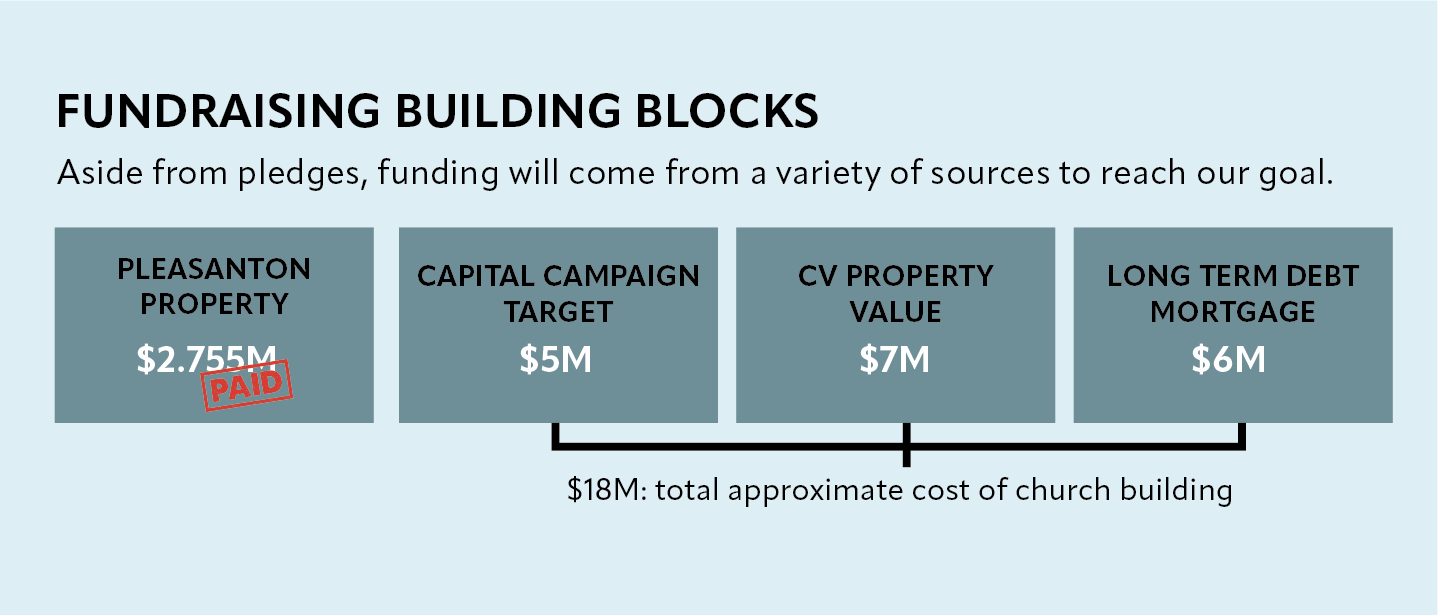
Our current goal is $5M. The total cost for the project is $18M. The funds for this will come from various sources: the sale of our Castro Valley property, fundraising from the capital campaign, and long-term debt/mortgage.
Why should I donate now when it may take years to build the church?
Hopefully it will not take years! We have already broken ground on the property, and the goal is for construction to follow very soon. It is important to clarify that a pledge does not mean a handover of committed cash immediately. It is expected that pledges will be made over a period of years based on the abilities of each parishioner. Some will pledge and pay a lump sum immediately or within the same year. Others will pledge and pay over 3, 5 or more years.
Why should I be expected to contribute if I don’t agree with moving the parish?
We give for our future, not for our present. Consider where our children and grandchildren will be worshipping in the years to come; where weddings and baptisms will take place; where we can grow our ministries and stewardship both in numbers and dollars; where we can reach out to unchurched Orthodox. Demographics have been consistently showing us for the last 20 years that growth will come in the tri-valley, not in Castro Valley. In a democracy such as ours it is inevitable, as well as healthy, to have opposing opinions. In the end, a majority voted to move. It is therefore incumbent on all of us to stand by our leadership and each other to make this move a reality.
With successive capital campaigns, can we afford a mortgage?
Capital campaign pledges are made over a period of one to 5 or more years. It is therefore expected that we will have to take out a mortgage for future building stages. Yes, we can afford one. At present, our parish can cover monthly interest and principal payments for a mortgage in excess of $1.5 million. That amount is likely to increase as we continue to build equity. More importantly, however, is that any mortgage will likely be short-lived with successful capital campaigns.